Organization Development The Process Of Leading Organizational Change Pdf Download
Recognizing the need for change and knowing how to brand that change successful are ii very different skills. Change management strategy is key—merely, where to begin? It all starts with understanding what types of organizational change you're making.
What is Organizational Alter?
Organizational changes are those that accept a significant impact on the organization every bit a whole. Major shifts to personnel, visitor goals, service offerings, and operations would all be considered forms of organizational modify. Information technology's a broad category.
Before you can blueprint your change management game programme, determine the type of organizational alter y'all'll be making. One time yous figure that out, you can execute the right alter management plan for the best possible results. Knowing the type of organizational change will also assist you cull the right change direction tools.
Why is Organizational Change Management Of import?
Organizational change is a business necessity. Employees leave, and new employees are hired, new teams and departments are created as the company grows, and businesses prefer new technology to stay ahead of the curve.
The key to successful, productive organizational change is the way you manage it. It's vital to proceed employees in the loop and ensure that they sympathise what the changes are and how employees volition be affected.
With constructive organizational change management, you can keep the business running smoothly during the transition. For example, offering preparation options helps employees learn new technology faster. That way, they fully prefer the technology, and the organizational change isn't bogged down by support tickets and frustrated users.
Past identifying the types of organizational change you lot will be implementing, y'all can make a plan for keeping employees informed. You lot tin ask for feedback as you implement the alter and then make adjustments to your change management plan then that your team has the support they need to maintain high morale and facilitate the change from their end.
Download our pack of 6 alter management templates to kick-start your change intiatives
four Types of Organizational Change
Unlike types of organizational modify volition crave different strategies. Everything from the implementation programme to the communication should be tailored to the type of alter you want to make. Before you begin strategizing for change, ask yourself: Is this alter strategic, structural, people-centric, or remedial?
Strategic and structural changes may call for additional training and gradual transitions, while a remedial change would require firsthand action. People-centric changes, on the other hand, do good from a well-idea-out change direction communication strategy, so you tin can navigate emotional reactions.
Here are the four most common types of organizational alter, along with examples for each ane:
1. Strategic transformational change
All changes volition touch on some aspects of a company, only not all changes are transformational.
Minor modifications to existing tools or policies volition influence simply non completely redefine a business. Large changes, on the other hand, transform companies. Whether that transformation is positive or disastrous depends on the strategy used to get in.
If you want serious results, you'll need to do some serious planning. You need to identify what the ultimate goal is then pattern a plan to achieve it. Preparation and ongoing change management are essential for implementing these large-scale types of organizational change.
Hither are three examples of strategic transformational change
1. Updating your mission as yous abound: When companies first launch, the initial focus is often on atomic number 82 generation and getting clients through the door. Even so, once the company has an established client base, the focus could shift to upselling, for example. When the principal mission changes, the company mission needs to evolve as well.
2. Introducing new technology: Engineering is designed to make our lives easier, just learning curves can make applied science-related changes tricky to implement. People generally prefer to stick with what they know.
When you introduce new technology, you need to have a solid plan for the transition. People want to know why the engineering science is necessary, what makes it better than previous solutions, and how you are going to support them during the transition.
For example, if you plan to switch from an outdated CRM to Salesforce, start by justifying the change. Explain that Salesforce will allow the squad to manage leads while also engaging with current customers. Exist certain to point out key benefits, like keeping marketing, customer relations, and detailed analytics all in once identify.
You tin can build confidence in the change by explaining that the transition volition be supported with various change management tools that offering capabilities such equally in-app grooming, weekly check-ins, and an internal chat for handling questions.
3. Employee training and development for new skills
Boosted training is a great way to back up existing talent while too helping the visitor evolve. It's important that employees understand that the goal is to support new strategies as opposed to fixing deficiencies. When presented properly, additional training will exist viewed as a benefit.
Employees will see that y'all are willing to invest in their personal growth.
Strategic transformational changes should be made gradually and monitored closely. Transformations don't happen overnight. You lot'll demand to make adjustments and piece of work closely with your squad as your strategy shifts.
2. People-axial organizational change
While all changes affect people, people-centric types of organizational modify include instituting new parental leave policies or bringing on new hires.
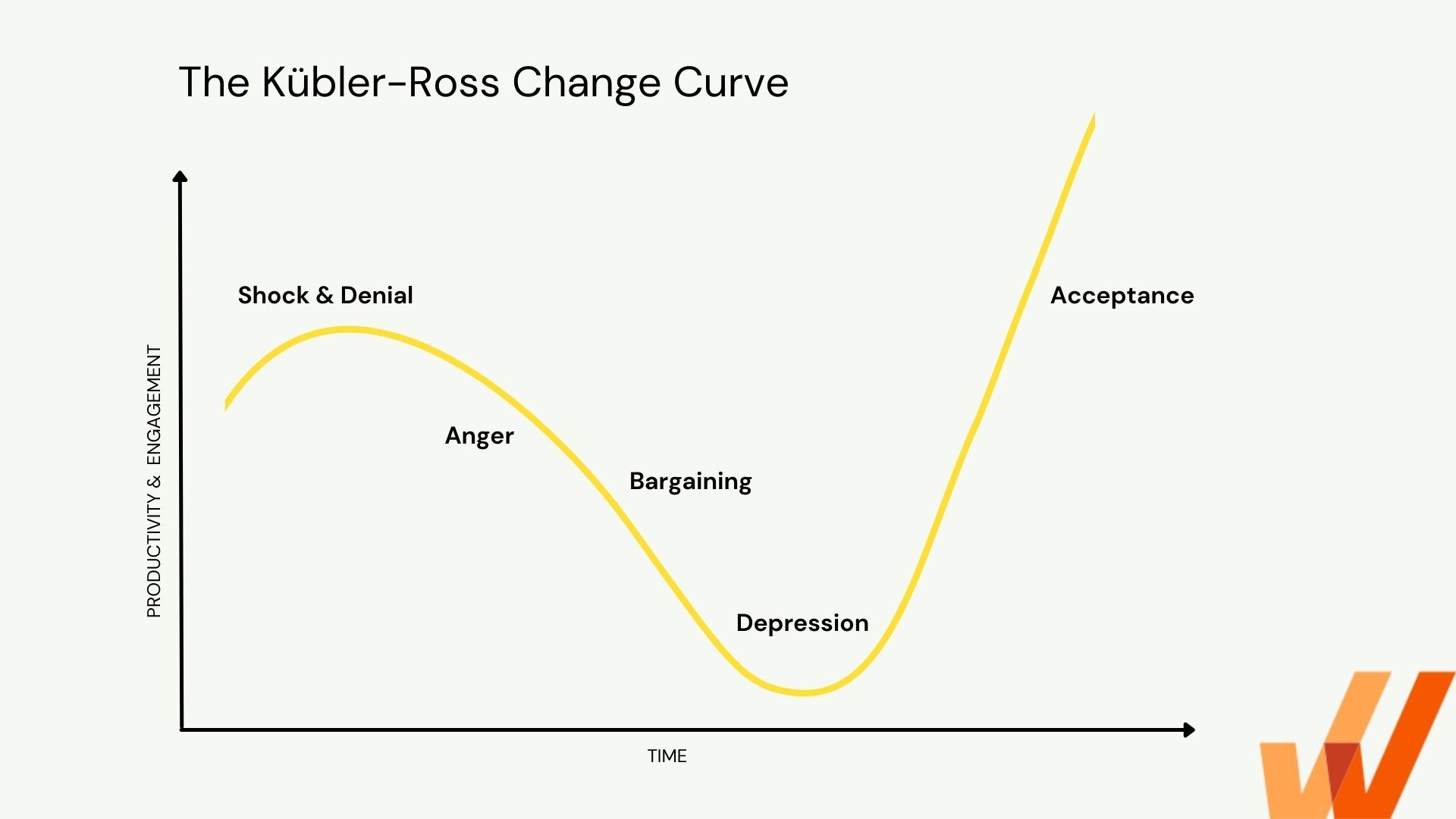
Fifty-fifty if you remember employees volition exist excited past the alter, an empathetic approach is key because emotional reactions are common. In fact, many change management models, such as the Kübler-Ross Change Bend and Satir Change Model, focus specifically on managing emotional reactions to change.
Here are iii examples of people-centric change
one. New hires:
Bringing on new team members requires onboarding and grooming, which can touch both the new hires and the established employees. Start with communication. Explain the reason for hiring new people.
Are they going to lighten the workload? Will they fill up in skills gaps? How volition they integrate with the current team?
Be ready to answer the WIIFM and WDIMTM questions and have a solid programme to avert negative reactions. Get ahead of concerns like the actress time it will take to train the new employees on existing tools.
If you explicate that the Whatfix Digital Adoption Platform will quickly get employees up to speed on current software, you volition show your team that you anticipated their concerns and planned ahead. You'll exist introducing change equally a solution instead of an obstacle.
2. Changes to roles and responsibilities:
Job descriptions can evolve over time. Changes to an employee'south responsibilities may crave additional preparation and restructuring of teams. Of form, shaking up routines is a delicate process. It'due south essential to have a strategy for change implementation and advice.
People like purposeful modify. Communicating the value of the change is essential. If you are adding a responsibility to someone's role, such as delivering monthly e-mail marketing reports, the employee will be more probable to receive the news well if she understands why.
Consider the following options for announcing the new responsibility:
- Option A:"Starting adjacent month, the marketing team will exist required to utilize Oracle to create monthly reports on email marketing efforts."
Option B: "Oracle's built-in analytics simplify the procedure of monitoring email marketing efforts and running reports. Harnessing those analytics will allow us to create detailed reports for clients and offer them more than value. Starting side by side calendar month, the marketing team will be in charge of creating and delivering reports to clients. "
Which selection do you lot think would be better received?
3. Employee training and evolution for new skills
Navigating policy changes is complicated. When you lot alter policies that directly affect employees, such as parental go out, vacation, or remote work policies, you risk extreme reactions.
Employees could experience cheated. As always, communicating the why behind the change is primal. Employees may non like the reason, only they will appreciate your honesty.
Recollect, people-centric changes are prone to emotional responses. Prepare for the emotional journey and be ready to guide your squad towards acceptance.
iii. Structural change
Structural changes involve major shifts in the direction hierarchy, team system, and the responsibilities attributed to unlike departments, employees, or teams. These changes frequently overlap with people-centric changes as they directly bear on most, if not all, employees.
Here are 3 examples of structural change
ane. Mergers and acquisitions:
Mergers and acquisitions are the most common cause of structural change. Eliminating function redundancies, redefining goals, clearly defining new roles and responsibilities, and training on engineering science are all important parts of managing change during mergers and acquisitions.
Lewin's Modify Management Model works well for mergers and acquisitions considering it focuses on creating a new status quo. It has three steps: unfreeze, change, refreeze.
After you unfreeze the electric current processes, you movement onto change. This footstep should exist gradual. This is when strategy is then crucial. Difficult changes, such as eliminating redundancies, require continuous and open up communication.
Encourage feedback and heed as much as yous talk. Once the changes are in place, you lot "refreeze" or solidify the modify equally the new status quo.
2. The creation of new teams or departments:
Structural change can also utilize to smaller adjustments, such as creating a new squad. If y'all notice that some employees have more than of a knack for analytics, you might decide to create a separate team dedicated to reporting. The necessary shifting of personnel and duties could create some tension.
Justify the alter with articulate reasoning and explain the benefits. Highlight the positives. It'southward non about taking away responsibilities – information technology's well-nigh playing to each individual'due south strengths.
3. Changes to the company organizational chart:
Promotions and new roles call for updates to the organizational chart. When moving people around, be sure to gloat wins, like promotions, and explain adjustments, such as merged departments.
Structural changes influence how your company functions as a whole. Information technology's never an piece of cake transition, but solidifying the change every bit before long as possible can assistance you avoid major issues down the line.
iv. Remedial modify
Remedial changes are reactionary. This type of change occurs when a problem is identified, and a solution needs to be implemented. As these changes are designed to address an issue; they phone call for immediate action.
Reactionary modify may non exist ideal, merely it's inevitable. The benefit of the remedial change is that judging its success is quick and simple.
Was the problem solved or not?
Hither are iii examples of remedial change
1. Dealing with a loss of talent:
When someone in a key position at the visitor decides to leave, you must adjust speedily. Your squad will have questions.
Will someone move into the office, or is the company searching for new candidates? Who volition take over the responsibilities immediately? How will this affect 24-hour interval-to-mean solar day operations?
Unexpected changes in personnel are difficult to prepare for. If y'all are blindsided, have some time to put together a statement. Announcing an employee's divergence before you have answers to the inevitable questions is a recipe for disaster.
Your employees volition wait to you for guidance. Make sure you are ready to provide it.
ii. Addressing customer advice issues :
There is a huge deviation between simply handling communication with customers and having an effective communication strategy. If what you're doing isn't working, you lot demand to adapt chop-chop.
Gaming visitor Activision realized that each time they released a game, customers had a lot of questions and feedback. Agents were prepared for a surge of incoming calls, but Activision realized that their customers preferred to go straight to social media. They had to change their process.
Activision used Salesforce to implement Marketing Cloud's Social Studio. Marketing Cloud automatically tracks relevant tweets and social media conversations and uploads them to Service Cloud. Now, customers can either exist directed to cocky-service solutions or connected to a live amanuensis.
"It'southward an incredible modify," Tim Rondeau, Activision's Senior Director of Client Care, told Salesforce. "We're reducing costs and increasing satisfaction at the same time."
It's easy to use stories similar this one as a reason for a change, simply don't forget to present answers to WIIFM and WDIMTM. If you were to announce a like change to your customer service team, you'd want to focus more on how information technology affects them personally.
In this case, the WIIFM is that employees will spend less fourth dimension on repetitive questions. The WDIMTM is that they'll demand to be trained on Salesforce Marketing Cloud.
iii. Providing more preparation for new hires:
Highly inefficient processes often atomic number 82 to remedial changes. You might notice that new employees are struggling to acquire internal tools and software. As a result, they are running to established employees with questions. Time is wasted, and anybody ends up frustrated.
In this example, the remedial modify could include a combination of a user onboarding program for awarding training, a company wiki for bones company cognition, and an onboarding handbook with knowledge resources that promote self-guided learning.
Remedial changes begin with an issue and cease with a solution.
It seems simple, but since these changes are reactionary, they can oftentimes involve some trial and fault. Quick action means y'all won't have as much fourth dimension to program or transition. The strategy comes into play through monitoring the change. The remedial change is but successful if the identified problem has been solved.
Know your modify and own your strategy
Designing a change implementation strategy before identifying the blazon of change you are dealing with is like skipping to chapter ten in a mystery novel and expecting to solve the law-breaking. You're setting yourself (and your change) upwards for failure. Take a step back and remember about why the change needs to happen.
Consider the obstacles. Think about who and what the modify affects. When you lot truly sympathize the type of modify you're making, you tin can dive into strategy.
Every change involves a learning bend. Whatfix Digital Adoption Solutions make the transition to new tools unproblematic through interactive in-app guidance.

Request a demo to see how Whatfix empowers organizations to support change projects by driving user adoption and providing guided walkthroughs.

Subscribe to get new content delivered directly to your inbox.
DOWNLOAD HERE
Posted by: kingwhattlial.blogspot.com
Enregistrer un commentaire